
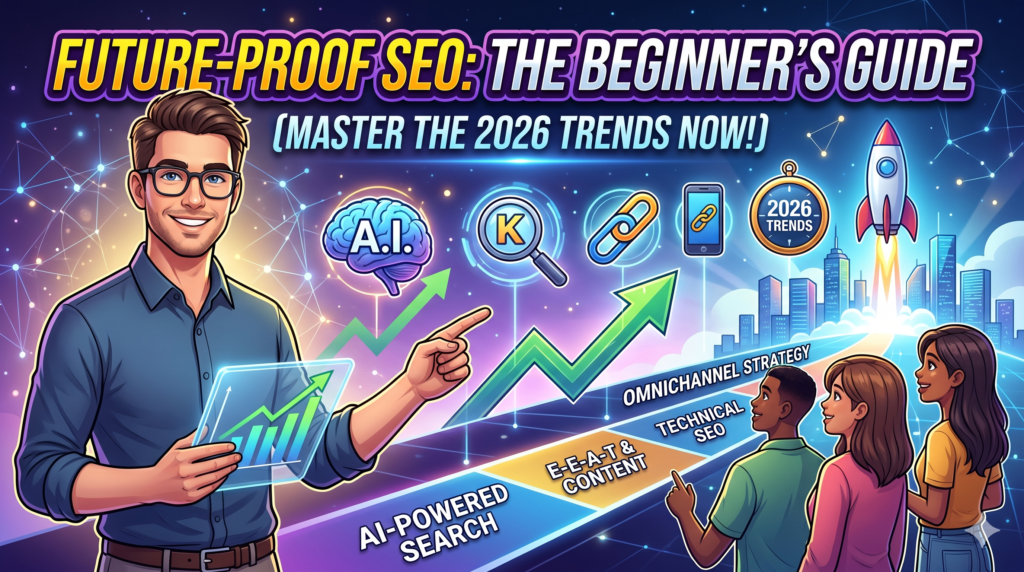
Best beginner SEO tutorials focusing on future trends
The Ultimate Guide to SEO in 2026 If you are new to the digital marketing field or just starting your online e-commerce journey, you have probably noticed one major thing: Google is no longer what it used to be. In the past, you could easily secure rankings just by repeating keywords (keyword stuffing) and building random backlinks. However, today’s internet is driven by AI. Google AI Overviews, ChatGPT Search, and Perplexity have completely changed the rules of the search game. There are countless resources available on the internet, but finding the perfect seo tutorials for beginner means looking for one that avoids outdated tricks and instead focuses purely on future trends (2026 and beyond). Most tutorials today still teach you how to rank in the traditional “10 blue links,” whereas true success today lies in getting your brand “cited” (mentioned) directly within AI-generated answers. In this comprehensive and easy-to-read guide, we are going to bridge this major information gap. We won’t rely on random, hypothetical scenarios; instead, we will use real-world industry examples to understand exactly how SEO functions in this new era. 1. The Big Shift: Traditional SEO vs. Generative Engine Optimization (GEO) The most significant shift happening right now is the transition from traditional SEO to GEO (Generative Engine Optimization). When people search for something today, AI provides them with a directly synthesized answer without them ever needing to click on a website. This means your new goal isn’t just to satisfy search engine algorithms, but to satisfy AI language models as well. If you are setting up an e-commerce business—let’s say an independent brand named Laxminarayan—and you want to build your website’s authority outside the ecosystems of Amazon or Flipkart, you must optimize for AI search. Feature Traditional SEO AI Search / GEO Primary Goal Ranking at the top of search engine result pages (SERPs). Getting “cited” (mentioned) in AI-generated direct answers. Strategy Focus Keyword search volume and acquiring external backlinks. Content extractability, semantic context, and brand authority. Content Style Long, text-heavy content stuffed with target keywords. “Atomic Answers,” structured data, and clear, verifiable facts. Metrics Clicks, impressions, and exact keyword rankings. AI visibility, unlinked brand mentions, and share of voice. 2. Technical Foundation: The Silent Ranking Factor Technical SEO has always been crucial, but in 2026, AI crawlers instantly ignore websites that are slow or have a convoluted structure. An AI crawler simply will not waste its computing power on a site with a complex architecture. Core Web Vitals If your website takes 5 seconds to load, an AI engine won’t even crawl it to source answers. You need to pay strict attention to 3 technical metrics: Structured Data (Schema Markup) Telling the AI exactly what your page is about is the most vital step you can take. For example, if you are marketing for luxury jewelry brands (like Aurix Fine Gold or Padmashree Jewellers) and you have a landing page for a “10gm gold coin” or “925 silver jewelry,” using Product Schema is non-negotiable. This feeds the AI crawler the exact price, gold purity, and stock availability instantly, allowing it to directly showcase your product when a user enters a relevant query. 3. Content Strategy: E-E-A-T and “Atomic Answers” The entire approach to content writing has evolved. AI engines now exclusively pick content that demonstrates clear authority and clarity. Generic, mass-produced content from AI factory websites is actively being penalized. The Power of E-E-A-T Google and AI models rigorously evaluate who wrote the content based on E-E-A-T (Experience, Expertise, Authoritativeness, Trust). If you work in the sustainable energy sector, let’s say for a brand like Tirupati Solar, your ground-level experience must reflect in your writing. Simply copy-pasting the “benefits of solar energy” from the internet won’t work anymore. You need to provide real-world, localized data—such as “How the solar panel adoption rate is increasing in Surat,” or “How panels are maintained in the specific weather conditions of Gujarat.” When you showcase genuine, practical expertise, AI recognizes you as a trusted source. Atomic Answers (The Format AI Loves) AI models do not want to parse through massive walls of text. They look for short, direct answers of 40-60 words that they can easily extract and present to the user. 4. Topic Clusters & The “Query Fan-Out” Concept In the past, marketers would stuff 50 different keywords into a single article. Today, AI breaks down a single user query into 8-10 related sub-queries. This is known as Query Fan-Out. Instead of writing blogs on random, unrelated topics, you need to build Topic Clusters. This works like a hub-and-spoke model. Suppose your Pillar (main hub) page is: “The Ultimate Guide to Buying Gold Jewelry”. Beneath that, your Clusters (spoke pages) should include detailed sub-topics like: When you properly interlink all these detailed pages, your website establishes “Topical Authority” in that specific niche. The AI begins to recognize your domain as possessing complete, A-to-Z knowledge on the subject. 5. Visual SEO and Omnichannel Synergy Moving forward, people won’t just type to search. Voice search and Visual search (like Google Lens) are growing at an exponential rate. Video and Visual SEO The time users spend on your page is a massive SEO factor. If you embed high-quality cinematic commercials or multi-scene drone videos on your landing pages, users will stay significantly longer. A visually stunning 8-12 second commercial holds the user’s attention, reduces the bounce rate, and signals to search engines that the page is highly engaging. Always ensure you add descriptive file names and Alt-text to your videos and images. Leveraging Meta Business Portfolios & Platforms Focusing solely on your website is no longer enough; AI tracks your off-page presence as well. If you have studied concepts like the Meta Business Portfolio and Facebook Ads, they apply directly here. When your social media accounts are highly active, generating engagement, and people are naturally discussing your brand name, AI counts those “unlinked brand mentions” as strong trust signals. For e-commerce businesses (whether selling on Amazon or a D2C site),
Best beginner SEO tutorials focusing on future trends Read More »